
Portfolio · Department of Atomic Energy
Atomic Energy
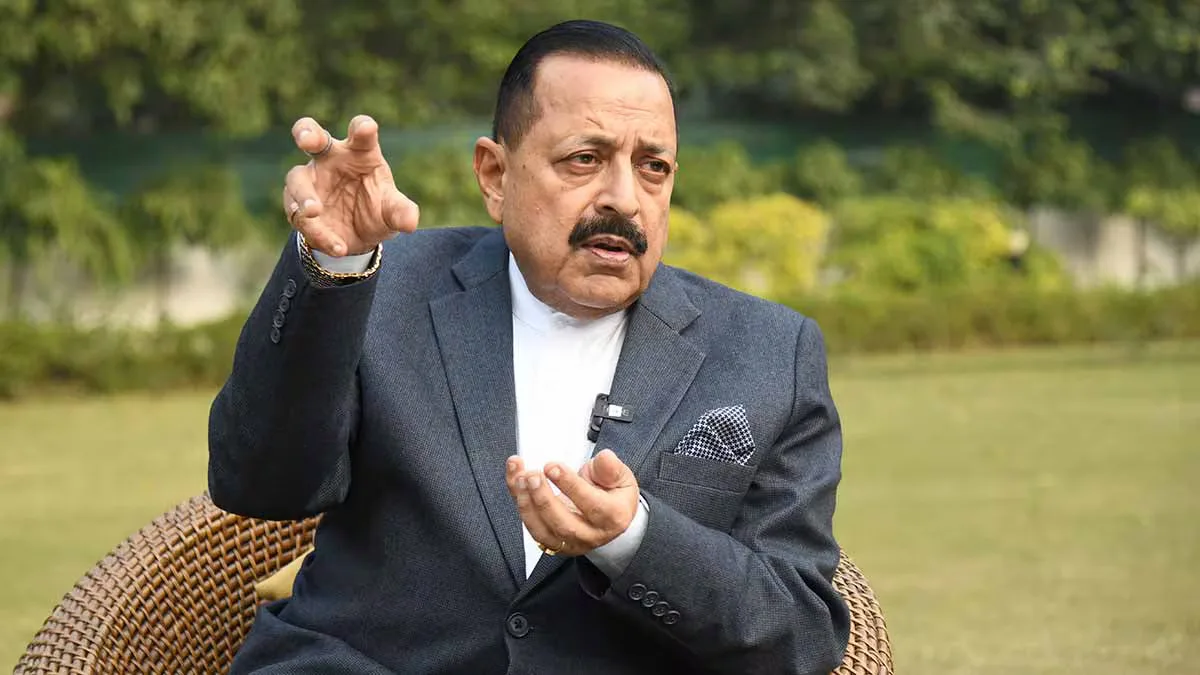
The Department of Atomic Energy (DAE) comes under the Prime Minister. Dr. Jitendra Singh is the Minister of State in the Department. In that role he answers questions on nuclear power and research in Parliament, pilots legislation, and represents the Department at its institutions.
Sheet 01 · Role
Institutional position
The Prime Minister holds the Department of Atomic Energy and the Department of Space. The official portfolio list of the Union Council of Ministers names Dr. Jitendra Singh as Minister of State in both. The Department's technical programmes are carried out by its own institutions and enterprises, including:
- the Bhabha Atomic Research Centre (BARC);
- the Indira Gandhi Centre for Atomic Research (IGCAR);
- the Nuclear Power Corporation of India Ltd (NPCIL);
- BHAVINI;
- the Tata Memorial Centre;
- aided institutions such as the National Institute of Science Education and Research (NISER).
The Atomic Energy Regulatory Board (AERB) regulates safety. This page does not attribute these institutions' technical work to the Minister.
PM India — Portfolios of the Union Council of Ministers · dae.gov.inSheet 02 · Nuclear power
Installed capacity & stated trajectory
Solid bars show recorded capacity. Outlined bars show projections that Dr. Jitendra Singh gave in the Rajya Sabha on 12 February 2026. They are targets, not outcomes.
Installed capacity is “8,780 MW comprising of 24 nuclear power plants (excluding RAPS-1 – 100 MW)”. A further 17 reactors totalling 13,100 MW are under implementation and are expected “progressively by 2031-32”.
Parliament answer, 5 Feb 2026 · PIB 2223790“In the last two years a capacity of 2100 MW has been added by completion of KAPP 3&4 (2X700 MW) and RAPP-7 (700 MW)”. Generation rose from 47,971 MU in 2023-24 to 56,681 MU in 2024-25.
Parliament answer, 4 Feb 2026 · PIB 2223268Other points from the 12 February 2026 statement: Kudankulam Units 3–4 are targeted for 2026–27 and Units 5–6 by 2030. On Jaitapur (6 × 1,600 MW), the Minister said a “technical agreement framework is in place” and that commercial aspects are under consideration. PIB 2227041
Sheet 03 · Legislation
The SHANTI Act, 2025
The Sustainable Harnessing and Advancement of Nuclear Energy for Transforming India (SHANTI) Bill, 2025 replaces the Atomic Energy Act, 1962 and the Civil Liability for Nuclear Damage Act, 2010. Dr. Jitendra Singh introduced it and piloted it through both Houses.
- 15 Dec 2025PIB 2204236
Introduced in Parliament
The Bill gives the Atomic Energy Regulatory Board statutory status, revises the nuclear liability framework, and creates an Atomic Energy Redressal Advisory Council and a Nuclear Damage Claims Commission.
Policy - 17 Dec 2025PIB 2205519
Reply to the debate, Lok Sabha
The Minister said operator liability now carries “graded caps linked to reactor size”. He said private entities would not control sensitive materials and spent fuel would remain with the government. He also cited a “nearly 170 per cent increase” in the DAE budget over the decade.
Ministerial statement - 18 Dec 2025PIB 2206211
Rajya Sabha discussion
After the Lok Sabha passed the Bill, the Minister took part in the Rajya Sabha discussion and restated the principle “safety first, production next”.
Ministerial statement - 22 Dec 2025newsonair.gov.in
Presidential assent reported
News On AIR, the public broadcaster's news service, reported that the President had granted assent. The report does not give the exact date of assent.
Reported outcome - 17 Apr 2026PIB 2253013
Operationalisation workshop
The Central Electricity Authority, the Ministry of Power, DAE and NTPC held a workshop on putting the Act into operation. The release does not list the Minister as a speaker.
Implementation
Nuclear Energy Mission & small modular reactors
The Union Budget 2025-26 “allocated ₹20,000 crore for R&D in Small Modular Reactors, targeting at least five indigenously designed operational SMRs by 2033”. This supports the Mission's objective of 100 GWe of nuclear capacity by 2047.
A Lok Sabha written reply of 12 August 2026 lists the reactor designs under development at BARC:
- the 220 MWe Bharat Small Modular Reactor (BSMR-200);
- a 55 MWe SMR-55;
- a High Temperature Gas Cooled Reactor of up to 5 MWth, for hydrogen production.
The same reply refers to an Isotope Production Reactor for medical isotopes. BSMR-200 and SMR-55 units are planned at Tarapur.
In a media interview on 5 February 2025, Dr. Jitendra Singh described opening the nuclear sector to private participation as “revolutionary”. At a media round table on 21 January 2026 he said: “Renewables are growing rapidly, but nuclear remains the most reliable source of uninterrupted base-load power…”
PIB 2100108 · PIB 2298208 · PIB 2223268 · PIB 2217027Prototype Fast Breeder Reactor, Kalpakkam
On 4 March 2024 the Prime Minister witnessed the start of core loading of the 500 MWe Prototype Fast Breeder Reactor (PFBR) at Kalpakkam. BHAVINI built the reactor with the participation of more than 200 Indian industries.
According to a parliamentary answer of 5 August 2026, the PFBR “successfully attained its first criticality on 6th April, 2026”. The answer names the Indira Gandhi Centre for Atomic Research as its principal architect. The fast breeder reactor is the second stage of India's three-stage nuclear programme.
PIB 2011347 · PIB 2294812Radiation technology in agriculture & food
According to a parliamentary answer of 20 March 2025, “37 Gamma Radiation Processing Plants are operational” in India. Twenty-one of them can process agricultural and food products. The Department has transferred the technology to private entrepreneurs. Radiation processing is used to extend shelf life, control pests and sterilise medical products.
PIB 2113252Tata Memorial Centre & cancer care
The Tata Memorial Centre, an aided institution of DAE, runs a network of cancer hospitals. In replies in Parliament on 18 December 2025, Dr. Jitendra Singh said that “since 2014, 11 Tata Memorial Centre hospitals have been established”, and that the National Cancer Grid now links more than 300 hospitals.
A parliamentary answer of 11 March 2026 lists the Centre's hospitals by city and commissioning date. It also records a 200-bed Homi Bhabha Cancer Hospital under construction on the NISER campus at Jatni, Odisha, with commissioning expected in May 2026.
PIB 2206213 · PIB 2238314Education & scientific talent
On 13 July 2026 Dr. Jitendra Singh addressed the 15th Graduation Ceremony of the National Institute of Science Education and Research (NISER), Bhubaneswar, where 260 students graduated. The Vice President, Shri C. P. Radhakrishnan, was Chief Guest. The Minister recalled Homi Bhabha's legacy and cited current installed capacity and the 2032 target.
This is the handing over of a legacy of scientific excellence, innovation and national responsibility to a new generation.
On 17 August 2026 he met International Olympiad 2026 medal winners nurtured under DAE programmes, who had attended the 80th Independence Day celebrations at the Red Fort as special guests.
DAE — NISER graduation · DAE — Olympiad achieversRare earths & supply chains
In Lok Sabha Question Hour on 11 February 2026, the Minister said that measures under the SHANTI Act would speed up development of rare earths. The release headline refers to a target of 5,000 tonnes of magnet production by 2030. At the NISER ceremony in July 2026 he mentioned four Rare Earth Corridors, one of them in Odisha. A written reply of 18 March 2026 sets out a customs duty exemption on nuclear fuels and reactor components up to 2035, and NPCIL's supply-chain measures for the fleet of ten 700 MW PHWR units.
PIB 2226555 · PIB 2241715Related
Space & the science portfolio
The Department of Space also comes under the Prime Minister, with Dr. Jitendra Singh as Minister of State. Parliamentary replies on both departments are listed on the Parliamentary Record page.