Independent informational profile. Not an official Government of India website.
Portfolio · Ministry of Science and Technology
Science & Technology
Dr. Jitendra Singh holds the Ministry of Science and Technology as Minister of State (Independent Charge). This page sets out what the portfolio covers, the national programmes run through it, and what he has said about them in public, with each kind of item labelled separately.
Portfolio verified: 23 September 2026MoS (Independent Charge)
Fig. 01Dr. Jitendra Singh speaking at a public event. The supplied archive does not record the event or date.
How to read this page
Policy / Programme
What the Union Cabinet or a ministry approved, with the approval date and outlay stated in the official release.
Implementation
What the responsible department or institution reports it has done.
Ministerial statement
What Dr. Jitendra Singh said in public, attributed to the date and occasion.
Reported outcome
A result given in an official source, attributed to that source. It is not presented as a personal achievement.
01 · The portfolio
What the Ministry comprises
The Ministry of Science and Technology is made up of three departments. Each has its own secretary, budget and network of autonomous institutions. Being Minister of State (Independent Charge) means holding ministerial responsibility for the ministry without a Cabinet Minister above him in it.
Department I
Department of Science & Technology (DST)
DST funds research and builds scientific capacity. It is the administrative department for the Anusandhan National Research Foundation, and nodal department for the National Quantum Mission, the Research Development and Innovation Scheme and the National Geospatial Policy. The Technology Development Board and the Survey of India come under it.
DBT runs biotechnology research, the BioE3 policy for biomanufacturing, and support for biotech startups through the Biotechnology Industry Research Assistance Council (BIRAC).
Department of Scientific & Industrial Research (DSIR)
DSIR is the administrative department for the Council of Scientific and Industrial Research (CSIR) and its network of national laboratories. The Minister's documented CSIR engagements include foundation days and laboratory reviews.
A note on attribution. National scientific programmes are approved by the Union Cabinet and carried out by departments, institutions, scientists and, more and more, private companies. On this site a programme appears under this portfolio because the Ministry administers it. That does not mean any one person created it or produced its results.
02 · Programme register
National missions & schemes
Approval dates and outlays are as stated in Press Information Bureau (PIB) releases. Two programmes predate his current tenure at this Ministry, which began in July 2021. They are included because the Ministry administers them now.
Science & technology programmes administered through the Ministry
Programme
Approved
Outlay (as stated)
Type
Source
National Quantum Mission Quantum computing, communication, sensing and materials. Four thematic hubs.
Research, Development & Innovation (RDI) Scheme Long-term low- or nil-interest financing and equity for private-sector R&D, through a Special Purpose Fund within ANRF.
A PIB release on a DST review in April 2026 reports that the Minister was told a 1,000-km quantum communication network had been demonstrated. The technology came from QNu Labs, a startup supported under the Mission. The same release says Mission support now extends to 17 startups. The release is internally inconsistent about how long after launch this happened, so this page gives no duration.
The Union Cabinet approved the Anusandhan National Research Foundation Bill on 28 June 2023, at an estimated cost of ₹50,000 crore over five years (2023–28). Under the law:
the Prime Minister is ex-officio President of the Foundation's Governing Board;
the Union Ministers of Science & Technology and of Education are ex-officio Vice-Presidents;
the Department of Science & Technology is the administrative department.
The Lok Sabha passed the Bill on 7 August 2023 and the Rajya Sabha by voice vote on 9 August 2023. It became Act No. 25 of 2023, and its provisions came into force on 5 February 2024.
Dr. Jitendra Singh piloted the Bill in Parliament. Replying in the Rajya Sabha on 9 August 2023, he said:
This is a Bill which is going to have a long-term effect, long term outcomes… To that extent, this is possibly history in making.
On 1 July 2025 the Union Cabinet approved the RDI Scheme, with a corpus of ₹1 lakh crore, to fund private-sector research and development through long-term loans at low or nil interest and through equity, especially for startups. It has two tiers: a Special Purpose Fund sits within ANRF and allocates money to second-level fund managers. The ANRF Governing Board gives overall strategic direction, and DST is the nodal department.
Implementation so far, as reported:
4 February 2026: Dr. Jitendra Singh launched the Technology Development Board's first RDI open call. It offers up to 50% project funding for technologies at Technology Readiness Level 4 and above, and collateral-free loans at 2–4% over up to 15 years.
13 February 2026: the first national call of the ₹2,000 crore BIRAC–RDI Fund was announced.
16 May 2026: TDB and DST signed agreements for five RDI projects and released the first disbursement.
The Union Cabinet approved the BioE3 (Biotechnology for Economy, Environment and Employment) Policy on 24 August 2024. It supports high-performance biomanufacturing through Biomanufacturing and Bio-AI hubs and biofoundries. Its thematic sectors include bio-based chemicals, biopolymers and enzymes, and smart proteins.
At BIRAC's 14th Foundation Day on 19 March 2026 the India Bioeconomy Report 2026 was released. Dr. Jitendra Singh cited it for these figures:
India's bioeconomy grew from about US$10 billion in 2014 to more than US$195 billion in 2025, about 5% of GDP;
the target is US$300 billion by 2030;
there are over 11,800 biotech startups.
These are the Minister's figures, taken from the report. In an earlier speech on 13 February 2026 he gave the 2014 baseline as about US$8 billion.
On 3 September 2026 he launched BIO-NIVESH and held a startup–investor roundtable, where he said “innovation is incomplete without investment, while investment will not sustain itself without innovation.”
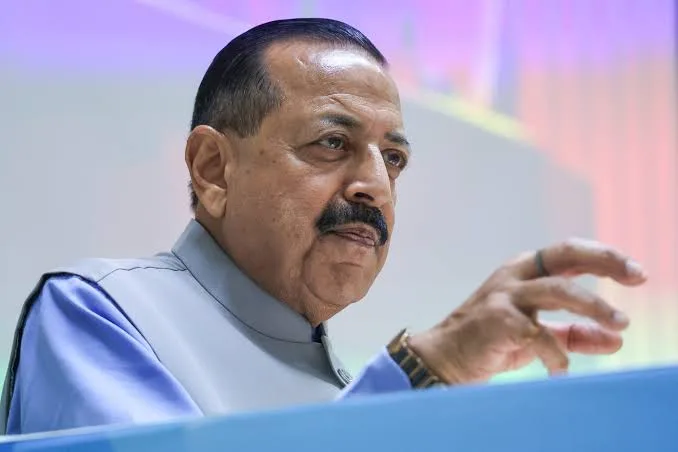
Fig. 02At a lectern bearing Department of Biotechnology branding. The archive does not record the date.
ImplementationMinisterial statement
Women in science
According to a parliamentary reply of 23 July 2025, DST's gender-focused programmes include:
WISE-KIRAN, with four components: WISE-PhD, WISE-PDF, WISE-SCOPE and WISE-IPR, a one-year internship in intellectual property rights;
WIDUSHI, for senior women scientists who are retired or retiring;
CURIE, for research infrastructure in women's universities;
GATI, for gender advancement in institutions.
Vigyan Dhara, approved in August 2024, also includes measures aimed at gender parity in science, technology and innovation.
The theme of National Science Day on 27 February 2026 was “Women in Science: Catalyzing Viksit Bharat”. At the INSA Auditorium, New Delhi, an ANRF–Venture Centre outreach initiative and a Hydrogen Valley Innovation Cluster were launched. At the launch of the Bharat Forecast System on 26 May 2025, whose development was led by four women scientists, Dr. Singh said: “Science Ministries no longer empower women — we are being empowered by them.”
Many of the Minister's recent statements on science and technology come back to one theme: moving laboratory research more quickly into industry and the market.
CSIR's 84th Foundation Day, 26 September 2025: he said “Technology sovereignty will determine the geopolitical sovereignty in the times to come.”
Review of CSIR laboratories at Tirupati, 26 December 2025: he called for faster technology transfer to industry.
“Vigyan TECH 2026”, National Technology Day, 11 May 2026, at BRIC-NII: fourteen science ministries and departments took part.
Each figure is attributed to the source that published it and dated. Where the Minister's figures differ from those in formal government documents, the formal source is given first.
38thIndia's rank in the Global Innovation Index 2025, up from 66th in 2019Economic Survey 2025-26 · PIB 2219992
2lakh+DPIIT-recognised startups in 2025, up from about 500Economic Survey 2025-26 · PIB 2219992
11,800+Biotech startups, as stated by the MinisterMinisterial statement, 19 Mar 2026 · PIB 2242405
3rdIndia's global rank in scientific publications, 2020 (dated figure)US NSF S&E Indicators 2022, cited 18 Dec 2022 · PIB 1884582
Government releases use different Global Innovation Index baselines. On 23 September 2025 the Minister described India's rise as “from 81st position in 2015 to 39th in 2025”, and on 11 May 2026 as from 80th to 38th. This page uses the Economic Survey figure.
05 · Continue
Related areas of the portfolio
Each area below has its own page, with the same labels and source notes.